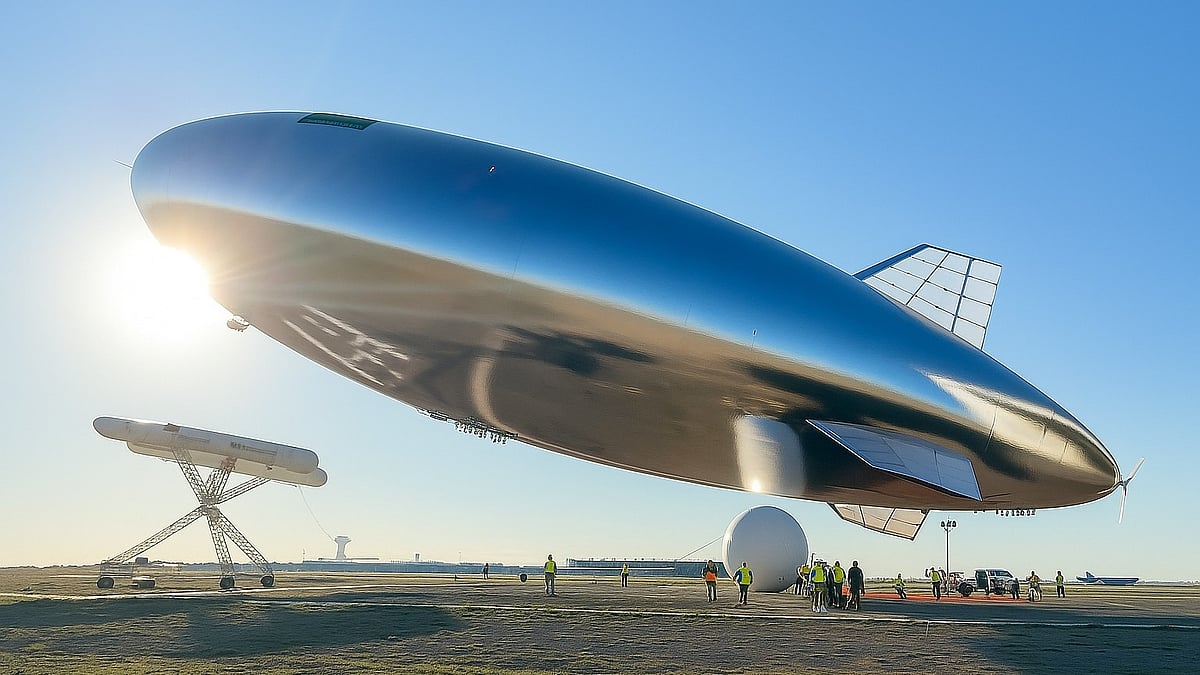
1. Specifications Explain What an actual platform can do
There's a tendency within the HAPS industry to talk about ambitions instead of engineering. Press releases cover coverage areas agreement with partners, commercial timelines. But the more challenging and more revealing conversation is about specifications - how much the vehicle actually weighs, how long it actually can be kept up, and what systems of energy make continuous operation possible. For anyone trying figure out whether a stratospheric platform is really mission-capable or merely at the stage of proving prototypes, performance of the payload, endurance measurements and battery performance are the places where the essence lives. Inconsistent promises to "long endurance" and "significant payload" are a given. Delivering both simultaneously while at a higher altitude is the challenge in engineering that differentiates credible programs from the frenzied announcements.
2. Lighter-than air architecture alters the payload Equation
The reason the airship design can support a significant payload is buoyancy takes care of the most fundamental job of keeping the vehicle airborne. This is a significant distinction. Fixed-wing solar planes need to create aerodynamic lift indefinitely which uses energy and can impose structural constraints that limit the quantity of mass the vehicle is able to be able to carry. Airships that are floating at the top of the atmosphere doesn't use energy fighting gravity in the same manner- thus the power generated from its solar array and also the structural capacity of the vehicle can be directed toward propulsion, station-keeping, and paying load operation. The result is a payload capacity that fixed-wing HAPS designs have the same endurance genuinely struggle to match.
3. Payload Capacity determines mission versatility
The practical importance of higher payload capacities becomes apparent as you think about the kind of stratospheric assignments actually require. A payload in telecommunications -- antenna systems such as signal processing hardware, beamforming equipment has significant weight and volume. So does a greenhouse gas monitoring suite. Also, a wildfire detection and earth observation sensors. The ability to run any of these missions adequately requires equipment that is large. Multiple missions at once requires more. Sceye's airship specs are designed by the premise that a stratospheric airship should be able to carry a genuinely beneficial combination of payloads instead than forcing operators to choose between observation and connectivity, since it isn't possible to carry both at the same time.
4. Endurance Is Where Stratospheric Missions win or lose
A platform that reaches stratospheric altitude for the duration of 48 hours prior drop is useful for demonstrations. A platform that holds position for months or weeks at a time is useful for making commercial services. The difference between those two outcomes is almost entirely an energy based issue -- specifically, whether or not the vehicle is able to generate enough solar power in daylight to operate all systems and charge its batteries adequately to enable full function through the night. Sceye endurance goals are based on this challenge during the day in which we consider the ability to sustain energy for the entire night not as a flimsy goal but as a basic design requirement that everything else should be designed around.
5. Lithium-Sulfur Batteries Are a True Step toward a Significant Change
The battery technology that powers conventional consumer electronics and electric vehicles, particularly lithium-ion has energy density characteristics that pose real limits for endurance applications in the stratospheric. Every kilogram of mass carried by the aircraft is a kilogram that's not used to payload, however you'll need sufficient stored energy to keep a massive device operating all night. The chemistry of lithium-sulfur batteries alters this equation substantially. At energy densities as high as 425 Wh/kg for lithium-sulfur batteries, they can hold significantly more energy per pound than similar lithium ion cells. For a weight-constrained vehicle where every Gram of battery mass will have an opportunity cost in payload capacity, that rise in energy density isn't just a matter of time, it's significant.
6. The latest advances in solar cell efficiency are the Other Half of the Energy story
The battery's energy density determines how much energy you have the capacity to store. Solar cell efficiency determines the speed at which you can replenish it. Both matter, and the advancement in one without progress in one leads to a split energy structure. High-efficiency photovoltaic technology such as multi-junction models that take in a wider spectrum of solar energy, compared to traditional silicon cells have meaningfully improved the amount of energy harvested by solar-powered HAPS vehicles in daylight hours. When combined with lithium-sulfur storage these improvements are what makes a complete closed loop feasible: the ability to generate and store enough energy each day that all systems can be operated without the need for external energy.
7. Station Keeping Draws Constantly Out of the Energy Budget
It's easy to view endurance as merely remaining in the air. However, for the stratospheric platforms, staying airborne is only part of the energy equation. Station keeping -- staying in position despite the wind's stratospheric force via continuous propulsion draws power constantly and represents an enormous portion of energy consumption. The budget for energy has to accommodate station keepers alongside payload operation, avionics, communications, and thermal management systems at the same time. This is why specs of endurance that do not mention the specific systems operating during that duration are difficult for evaluating. Realistic endurance numbers assume complete operational load, not a just a minimally configured vehicle, with the payload off.
8. The Diurnal Cycle is the Design Constraint from which Everything else Remains in
Stratospheric engineers discuss the diurnal cycle, the rhythmic daily cycle that determines the amount of solar energy available -- as the central constraint around which platform architecture is based. During daylight, the solar array must generate enough power to operate every system, and then charge the batteries with enough capacity. In the night, the batteries have to power all systems until dawn without being moved, affecting load performance, or entering any kind of reduced capacity mode which could interrupt a continuous monitoring or connectivity mission. Finding a vehicle capable of threading this needle without fail, day after day, over months that is the principal engineering issue of solar-powered HAPS development. Every specification decision -- solar array area, battery chemistry, propulsion efficiency, and power draw of the payload -all are a result of this single primary constraint.
9. The New Mexico Development Environment Suits This Kind of Engineering
To develop and test a stratospheric airship requires airspace, infrastructure and conditions in the atmosphere that aren't found everywhere. Sceye's base in New Mexico provides high-altitude launch and recovery capabilities, crystal clear skies that allow solar research also access to extended, uninterrupted airspace that is required for continuous flight testing. There are many aerospace firms in New Mexico, Sceye occupies an unique position- that focuses on stratospheric lighter, than-air systems, not rocket launch programs that are commonly seen in the vicinity. The rigor of engineering required to validate endurance claims and battery performance under actual stratospheric conditions is precisely the kind of job that will benefit by a dedicated test space in contrast to the more impulsive flight programs that exist elsewhere.
10. Specifications that can withstand the scrutiny of commercial Partners Have to have
In the end, the main reason that specifications are important beyond the technical aspect is that the commercial partners making decision-making regarding investments need to know whether the numbers are factual. SoftBank's pledge to establish a nationwide HAPS infrastructure in Japan that will be able to offer pre-commercial services in 2026, rests by the assurance that the Sceye platform is capable of performing as intended in operating conditions and not just during controlled tests, but sustained over the mission durations commercial networks need. Payload capacity that is able to stand up with a complete telecommunications and observation suites aboard the aircraft, endurance statistics that are validated with actual operations on the stratosphere, as well as battery performance tested over actual diurnal cycles are what transform a promising aerospace programme into an infrastructure that a major telecoms operator is willing to stake its plans for network expansion on. Take a look at the recommended whats the haps for website tips including sceye disaster detection, Sceye HAPS, stratospheric internet rollout begins offering coverage to remote regions, sceye haps project updates, non-terrestrial infrastructure, what are high-altitude platform stations haps definition, whats the haps, Sceye endurance, HAPS investment news, Real-time methane monitoring and more.

How Stratospheric Platforms Shape Earth Observation
1. Earth Observation is always constrained by the position of the observer
Every improvement in humanity's capacity to track the surface of our planet has been based on finding an improved vantage point. Ground stations provided local accuracy but they were not able to reach. Aircraft increased range, but also consumed oil and required crews. Satellites brought coverage around the world, but introduced distance that traded resolution and revisit frequency against the scale. Each successive step up in altitude brought about some improvements while creating some others. The trade-offs associated with each technique have shaped what we know about our planet. And, most importantly, what we cannot see clearly enough to respond to. Stratospheric platforms are avantage location that lies between satellites and aircraft to solve some of the most persistent trade-offs rather than simply shifting them.
2. Persistence is the capacity for observation that alters everything
The most revolutionary thing a stratospheric platform offers earth observation. The key to this is not precision, nor the coverage area, and certainly not sensor sophistication. It is the persistence. The ability to watch the same location over time, for a period of days or weeks at a time, without gaps within the data record is a change in the kind of questions that earth observation will be able to answer. Satellites provide answers to questions about state: what does the current location look like this point? Persistent stratospheric platforms answer questions regarding the process -- how are things developing in the right direction, what is the rate is it influenced by what elements, and at what point should intervention be considered necessary? In the context of monitoring greenhouse gas emissions, the development of wildfires, the progression of floods, and coastal pollution spread, process questions are the ones to consider when making a decision, and they require continuity which only observation with persistence can offer.
3. The Altitude Sweet Spot Produces Resolution Satellites Are Not able to Match at scale
Physics determines the relationship among elevation, aperture for sensors, and resolution of the ground. A sensor operating at 20 kilometres can produce figures of ground resolution that require an incredibly large aperture to replicate from a low Earth orbit. This means that a stratospheric observatory can recognize individual infrastructure elements -- pipelines, storage tanks, land plots for agriculture, and vessels that are anchored in the oceanwhich appear as sub-pixel blurred images in satellites at similar prices to sensors. In cases such as monitoring oil pollution's spread from the specific offshore facility or identifying the precise site of methane leaks within a pipeline corridor or tracking the leading edge of a wildfire across challenging terrain, this benefit is directly translated into the details available to users and decision-makers.
4. Real-Time Methane Monitoring Became Operationally Effective From the Stratosphere
Methane monitoring via satellites has dramatically improved in recent years However, the combination revisit frequency and resolution limits is that satellite-based methane detection tends to detect large, long-lasting emission sources instead of sporadic releases from a few point sources. An stratospheric device that provides live methane surveillance over an oil and gas-producing zone, a large land area, or waste management corridor will alter this dynamic. Continuous observation at the level of stratospheric resolution can identify emission events as they occur, and attribute them to specific sources with precision that satellite information cannot deliver, and give the kind time-stamped source-specific evidence that regulatory enforcement and voluntary emissions reduction programmes have to function successfully.
5. Sceye's approach combines observation with the Architecture of Missions Broader
What differentiates Sceye's approach to stratospheric geospheric earth observation versus doing it as a single installation of sensors is integration of observation capabilities into the larger multi-mission platform. The vehicle that is carrying greenhouse gas sensors also includes connectivity equipment and disaster detection systems and conceivably other environmental monitoring payloads. This integration isn't just an cost-sharing plan, it shows a consistent view that all the data streams from multiple sensors are more valuable when used in conjunction rather than on their own. Connectivity platforms that also monitors the environment is more beneficial to operators. An observation platform that also can provide emergency communications is more valuable to governments. Multi-mission architecture increases the effectiveness of a single stratospheric deployment in ways that individual, purpose-built vehicles are not able to replicate.
6. Monitoring of the oil pollution impacts illustrates the operational benefit of close Proximity
The monitoring of oil contamination in coastal and offshore locations is a field in which stratospheric observing has significant advantages over satellite or aircraft approaches. Satellites are able to detect huge slicks but struggle to attain the resolution required for identifying pattern of spreading, shoreline interaction, and the behaviour of smaller releases preceding larger ones. Aircrafts are able achieve the needed resolution but cannot guarantee continuous coverage across large areas without excessive operational costs. A stratospheric platform holding position high above a coast can trace pollution events from their initial discovery through spreading, shoreline impact, and eventual dispersal. the continuous spatial and temporal data that both emergency intervention and legal accountability require. The ability to track pollutant levels over an extended observation window with no gaps is virtually impossible from any other type of platform at a comparable price.
7. Wildfires Observation from the Stratosphere Captures the Ground Teams' Unseen
The perspective that the stratospheric horizon provides over an active wildfire is qualitatively different to that available at ground-level or from aircrafts with low altitude. Fire behaviour in complex terrain such as spotting ahead of that frontal fire line, crown fire growth, and the interaction between fire and pattern of winds and fuel humidity gradients is apparent in its full spatial context when it is observed from a high enough altitude. The stratospheric platforms that monitor the active fire provides commanders with a near-real-time wide-area picture of fire behaviour which allows the deployment of resources based on what the fire is actually doing and not the specific issues that ground crews in particular regions are experiencing. Monitoring climate catastrophes in real moment from this viewpoint doesn't just improve response -in fact, it enhances the accuracy of decisions taken by the command team throughout an event's duration.
8. The Data Continuity Advantage Compounds Over the course of time
Individual observations are important. Continuous observations record a compounding value that increases non-linearly with duration. A week of stratospheric earth observation records over an agricultural region is used to establish the baseline. A month's data reveal seasonal patterns. The year encompasses the entire year's worth of crop development and water usage soil condition, as well as yield variations. The records of multiple years are the basis to understand what the regional landscape is changing in response to climate changes Land management practices and changes in the availability of water. for natural resource management applications -- forestry, agriculture or water catchment zone management, and more -This record of cumulative observations will often be more valuable than any individual observation event, however high its resolution or however timely its delivery.
9. The Technology That enables Long Observation mission is evolving rapidly.
Stratospheric earth observation is limited by the platform's ability to remain in the station long enough to generate useful data records. The energy systems that regulate endurance - solar cell effectiveness on stratospheric aircrafts lithium-sulfur batteries that have energy density close to 425 Wh/kg, as well as the closed power loop that runs every system during the diurnal cycle -- are evolving at a pace that is becoming more efficient in making multi-week or more than a month of stratospheric explorations operationally realistic rather than aspirationally scheduled. The work of Sceye's of New Mexico, focused on making sure that these energy systems are tested under real operational conditions instead of calculations from labs, is the kindof engineering progress that directly translate into longer observation missions as well as more beneficial data records for applications that depend on them.
10. Stratospheric Platforms Create an Environmental Layer that is New accountability
Perhaps the most impactful long-term effect of mature stratospheric earth observation capability is what it can do to the information surrounding environmental compliance and natural resource stewardship. When continuous, high resolution monitoring of sources of emissions, changes in land use water extraction, as well as pollution events are available on a continuous basis instead of frequently, the accountability landscape changes. Industrial operators, agricultural enterprises and governments as well as companies working in the field of resource extraction behave differently when they know that what they're doing is being continuously monitored from above and with information that is specific enough to be legally valid and timely enough to inform the regulatory response before the damage becomes irreparable. Sceye's stratospheric platforms, as well as higher-altitude platform stations pursuing similar observation goals, are developing the infrastructure for a world in which environmental accountability is rooted in continuous monitoring rather than periodic self-reporting - a change that's impact extends far beyond the aerospace sector that can make it possible. Follow the most popular Stratospheric platforms for website info including marawid, sceye earth observation, Stratospheric infrastructure, Sceye Softbank, what does haps stand for, sceye softbank partnership, detecting climate disasters in real time, HAPS technology leader, sceye haps payload capacity, sceye earth observation and more.